
JEE Main 2026 January 24 Shift 2 Paper Analysis: Moderate Difficulty, Chemistry & Maths Time‑Consuming, Physics Manageable
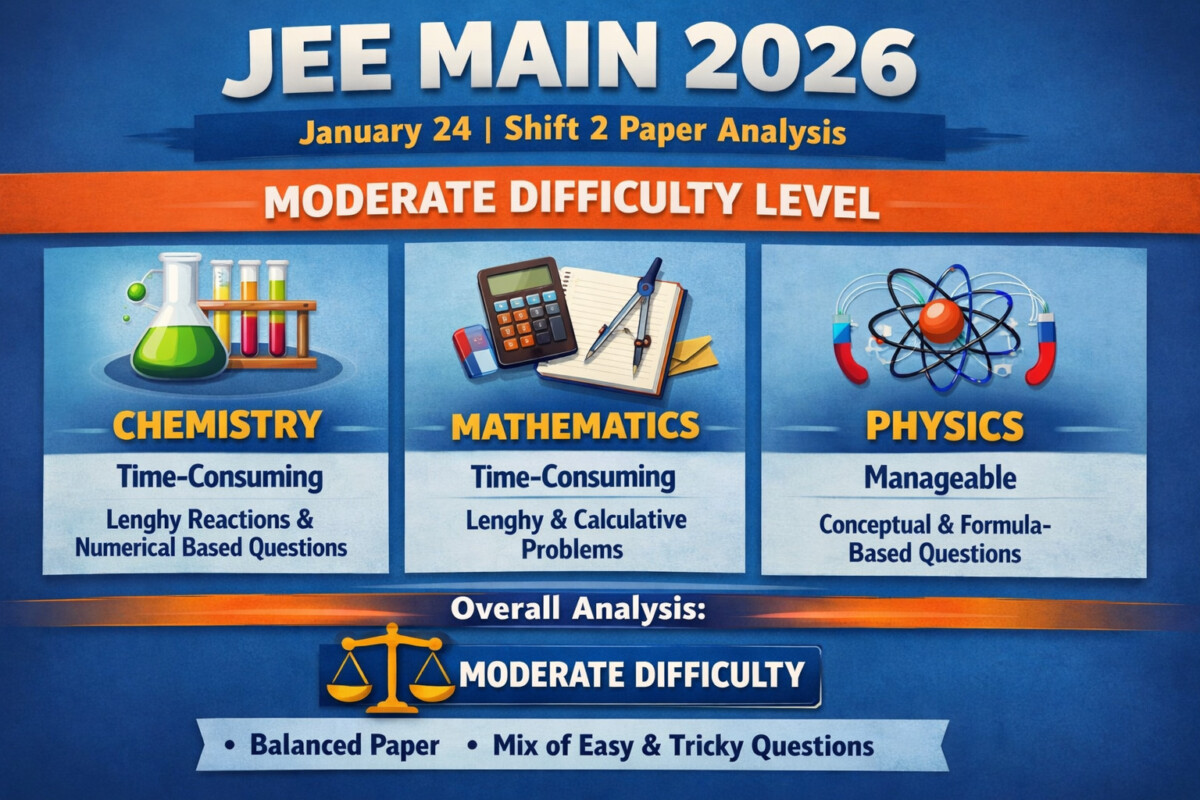
The JEE Main 2026 Session 1 January 24 Evening Shift (Shift 2) exam, held from 3 PM to 6 PM, concluded with a moderate overall difficulty level, according to subject experts and student feedback. Attendance on the day remained high, with over 96 percent of registered candidates appearing for the test across centres nationwide.
Overall Difficulty and Exam Pattern
The evening shift followed a pattern similar to the morning session on the same day, with all three subjects—Mathematics, Physics, and Chemistry—presenting questions largely based on the Class 11 and Class 12 syllabus. Among the three, Chemistry and Mathematics were time‑consuming, while Physics was relatively more manageable, allowing students to attempt a majority of its questions within the allotted three hours.
Session 1 of the JEE Main 2026 exams continues through January 29, and candidates who missed or plan to re‑attempt have upcoming shifts to prepare for.
Subject‑Wise Analysis
🧮 Mathematics: Lengthy & Conceptual
The Mathematics section in the evening shift was moderate in difficulty but time‑intensive due to several lengthy questions. Students needed careful calculation and good time management to handle questions that often required multiple steps to solve.
Major topic areas reported by candidates included:
Vector Algebra and Three‑Dimensional Geometry — foundational coordinate and spatial questions.
Sets, Relations and Functions — questions on relations and subset logic.
Integral Calculus — application of integration techniques.
Conic Sections — ellipse and related coordinate geometry problems.
Trigonometry — standard identities and functions.
Mathematics was considered tougher than Physics but slightly easier than Chemistry, though it demanded significant calculation attention.
🔬 Chemistry: Moderate to Difficult
Students found Chemistry to be moderate to difficult, especially compared with earlier shifts. Many questions were longer and more statement‑based, requiring students to interpret multi‑part prompts and combine conceptual understanding across topics.
Important areas tested included:
Electrochemistry
Coordination Compounds
Chemical Bonding
Mole Concept and Basic Chemical Principles
The length and complexity of many Chemistry questions made this section the most time‑consuming of the three for several candidates.
⚛️ Physics: Manageable & Concept‑Driven
Physics was generally more approachable relative to Mathematics and Chemistry in the evening shift. Questions focused on conceptual application rather than heavy computations, allowing many students to navigate this section with confidence.
Reported topics included:
Ray Optics
Electrostatics
Sound Waves (Organ Pipe)
Modern Physics (Radioactivity)
Fluid Mechanics
Current Electricity (Meter Bridge, Symmetry Problems)
Because many questions were directly tied to fundamental principles, students felt that a clear understanding of concepts helped in tackling this section efficiently.
Attendance & Conduct
The National Testing Agency (NTA) reported strong attendance across exam centres for the January 24 tests, reflecting consistent participation throughout Session 1. Biometric verification and standard exam protocols were enforced to ensure fairness and academic integrity.
Student Feedback & Reaction
Post‑exam reactions suggest the paper was balanced but required speed and accuracy. While Physics allowed many candidates to attempt most questions within the given time, Mathematics and Chemistry demanded extra effort and strategic time management.
Many students shared that the evening shift was comparable in difficulty to the morning session, with common feedback highlighting the length of questions rather than unusually tricky concepts.
What This Means for Scores and Percentiles
Though official results and normalized percentiles are yet to be released by the NTA, early expert impressions suggest that a high overall score will depend on efficient handling of lengthy Mathematics and Chemistry questions, in addition to scoring well in Physics. Detailed percentiles and normalized scores are typically published after all shifts conclude and answer keys are finalized.
Conclusion
The JEE Main 2026 January 24 Evening Shift (Shift 2) exam maintained a moderate difficulty level, with Chemistry and Mathematics being the most time‑intensive sections, while Physics provided relative scoring stability. Aspirants are now awaiting the official answer keys and final results, which will offer clarity on marks-to-percentile trends and admission prospects. Candidates preparing for upcoming shifts should continue focusing on time‑management skills, conceptual clarity, and strategic revision across all subjects.
Dear Students & Parents of Std 8 to 12- One Stop solution for career counseling – Vikas Kumar @ Psychographic Society -city center -club Road Ranchi
For more information call – 9570795071/9709534303
For Counselling Program Details – Click
Also Read-